How to Effectively Disinfect Dental Equipment: A Complete Guide for Dental Facilities
In dental clinics, safeguarding patient health depends on rigorous cleanliness. Understanding how to effectively disinfect dental equipment is essential—whether you’re a practitioner, a facility manager, or comparing cleaning services for your office. In this comprehensive guide, we’ll cover proven disinfection protocols, compliance with industry standards, decision points in workflow, essential checklists, and the unique requirements of modern dental environments. The aim is to provide actionable steps, authoritative advice, and clarity on why strict attention to dental equipment hygiene is non-negotiable in every Chicago dental practice.
Defining Dental Equipment Disinfection: What Makes It Unique?
Disinfection in the dental context goes beyond routine cleaning. Dental instruments and devices frequently contact blood, saliva, and mucous membranes, presenting a much higher risk of cross-contamination compared to many other professional settings. Disinfection, therefore, refers to the elimination of most pathogenic microorganisms—especially bacteria and viruses—on surfaces or instruments using chemical or physical means. However, sterilization (not just disinfection) is required for equipment that directly penetrates tissue.
- Critical items (e.g., scalers, forceps): Must be sterilized.
- Semi-critical items (e.g., mirrors, impression trays): Require high-level disinfection or sterilization.
- Non-critical items (e.g., dental chairs, countertops): Intermediate or low-level disinfection is usually sufficient.
Regulatory Standards Every Dental Office Must Follow
Before implementing any cleaning protocol, all dental facilities must comply with applicable local, state, and federal standards. This includes:
- CDC dental infection control guidelines: Establish baseline safety practices for U.S. dental healthcare settings.
- OSHA Bloodborne Pathogens Standard: Protects staff from occupational exposure.
- ANSI/AAMI/ASTM standards: Guidance on best-practice instrument processing. See ASTM Laboratory Standards for reference.
- State Board of Dentistry rules (Illinois or relevant local authority).
- AORN Guidelines: Particularly useful for those designing or updating protocols; see AORN’s Guideline Overview.
Always document your protocols and keep updated Material Safety Data Sheets (MSDS) for all disinfectants and sterilizing agents on site.
The Science Behind Disinfection: Microbial Risks in Dentistry
Dental equipment is especially vulnerable to contamination from pathogens like hepatitis B and C, HIV, Mycobacterium tuberculosis, influenza, and coronaviruses. These pathogens can survive on surfaces for extended periods if not eliminated through proper cleaning and disinfection. The risk of transmission is highest for critical and semi-critical instruments, underpinning the importance of selecting the right disinfection strategy for each equipment category.
- Biofilm formation in dental waterlines.
- Blood and tissue residues on instruments.
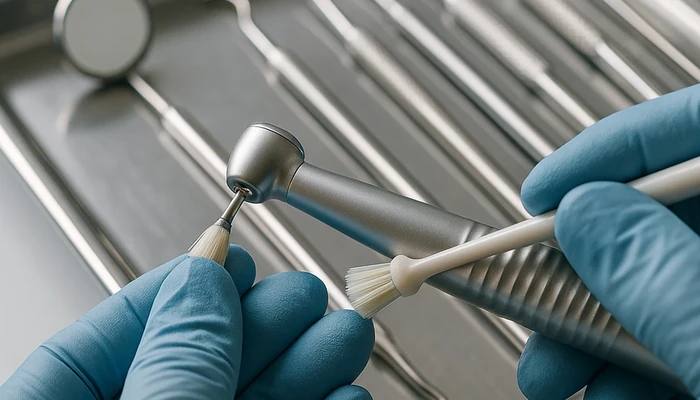
- Patient-to-patient transmission via improperly sanitized handpieces.
Differentiating Disinfection from Sterilization in Dental Practice
It’s crucial not to conflate disinfection and sterilization:
- Disinfection: Eliminates most pathogenic microorganisms (except bacterial spores) using chemical agents on inanimate objects. Used for surfaces and some instruments.
- Sterilization: Destroys all forms of microbial life, including spores, typically via autoclaving or high-level chemicals. Required for any device that enters sterile tissue.
High-touch surfaces (e.g., chair arms, switches) are disinfected between each patient, while tools like forceps must be sterilized.
Initial Steps: Preparing for Dental Equipment Disinfection
Before disinfection, preparation is key to maximizing effectiveness and safety. Follow these preparatory steps:
- Gather required PPE: gloves, eye protection, gown, and mask.
- Review manufacturer’s instructions for equipment care and cleaning agents.
- Set up a clean workspace with separation for ‘dirty’ and ‘clean’ zones.
- Inspect all instruments for visible debris or wear; discard single-use items.
- Ensure all staff handling disinfection have completed annual training updates.
This minimizes risk of injury and ensures protocols are followed correctly.
Step-by-Step: How to Effectively Disinfect Dental Equipment
- Wipe gross soil from instruments or devices using a disposable cloth or rinse under running water if permitted.
- Clean instruments manually with enzymatic detergent or in an ultrasonic cleaner (if appropriate). This reduces bioburden before disinfection.
- Rinse thoroughly and dry.
- Apply EPA-registered disinfectant according to product instructions. Ensure correct contact time (typically several minutes for complete efficacy).
- Allow to air dry or dry with a sterile towel before sterilization or reuse.
For surface disinfection (e.g., operatory counters, lights):
- Remove visible debris first.
- Use one-step disinfectant wipes for speed, but verify they meet required kill claims.
- Change gloves if you touch a non-disinfected item before resuming disinfection.
Key Decision Points: Choosing Disinfectants and Equipment Processing Methods
Different dental facilities may require different solutions based on volume, risk level, and equipment material. Consider these factors:
- Compatibility: Some disinfectants may damage sensitive items (e.g., handpieces)—always check equipment guides.
- Contact or dwell time: The disinfectant must remain wet on the surface for the prescribed duration to be effective.
- Staff and patient safety: Choose low-toxicity, non-irritating agents where possible.
- Broader antimicrobial efficacy: Ensure your agent is effective against tuberculosis, bloodborne viruses, and common oral pathogens.
Hydrogen peroxide, sodium hypochlorite, and quaternary ammonium-based products are commonly used but must be properly rotated to prevent resistance and sensitivity issues. Consult the ASTM disinfectant standards for guidance on selection.
Instrument Processing: Manual vs. Automated Cleaning Systems
Manual instrument cleaning is labor-intensive and exposes staff to greater risk, but is necessary for delicate tools. Automated options, such as ultrasonic cleaners or washer-disinfectors, are gaining popularity in high-volume practices:
- Manual cleaning pros: Lower equipment cost, suitable for delicate items.
- Manual cleaning cons: Greater exposure risk, variable consistency.
- Ultrasonic cleaners: Excellent for small, hard-to-reach surfaces; minimizes staff contact.
- Washer-disinfectors: Provide validated cycles, higher throughput, and consistent results; upfront cost is higher.
Use color-coded trays and well-labeled storage to prevent confusion between clean and dirty items.
Disinfection Frequency: When and How Often to Clean Dental Equipment
| Equipment Type | Frequency | Process Required |
|---|---|---|
| Critical instruments | After each use | Sterilization |
| Semi-critical instruments | After each use | High-level disinfection or sterilization |
| Non-critical surfaces | Between patients | Intermediate/Low-level disinfection |
| Dental waterlines | Daily/Weekly | Flushing, cleaning |
| Reusable PPE | Daily/Weekly | Cleaning/disinfection as directed |
Common Pitfalls: What Can Undermine Effective Disinfection?
Poor Staff Training
Lack of regular staff refresher courses often leads to shortcuts or inconsistent application of protocols.
Inadequate Cleaning Prior to Disinfection
Disinfection is not effective if visible debris remains. Organic soil blocks disinfectant action.
Improper Storage or Handling of Equipment
Cleaned items can become recontaminated if stored or transported improperly. Always use sealed trays and handle with clean gloves.
Expired or Incorrectly Used Disinfectants
Using expired products or not adhering to correct dilution/contact times renders the process ineffective and wastes resources.
Quality Assurance: Monitoring and Record-Keeping for Dental Disinfection
Documentation proves compliance and ensures continuous quality improvement. Implement these quality control elements:
- Maintain detailed cleaning/disinfection logs per operatory or instrument batch.
- Monitor staff performance with periodic audits or process checks.
- Test disinfectant potency regularly using test strips (if product requires verification).
- Review and update protocols annually or with any regulatory change.
Role of Professional Cleaning Services in Dental Equipment Hygiene
While in-house clinical staff typically handle instrument disinfection, partnering with a specialized cleaning provider ensures facility-level disinfection of treatment rooms, operatories, and common areas is always up to standard. An expert cleaning partner like Chicagoland Cleaning Services brings:
- Trained staff experienced in healthcare compliance.
- Consistent use of approved checklists and documentation.
- High-grade cleaning products suited to delicate dental equipment and surfaces.
- Flexibility for deep cleaning, move-out transitions, and recurring facility needs.
If you’re considering outsourcing non-clinical disinfection or want to supplement your team’s efforts, look for providers with healthcare cleaning experience, transparent communication, and a focus on long-term safety. You can compare general approaches in our overview of disinfection techniques for dental offices and primer on dental office cleaning.
Checklist: Daily and Weekly Dental Equipment Disinfection Tasks
- Disassemble and clean reusable instruments immediately post-procedure.
- Sanitize touchscreens, trays, counters, and dental chairs between each patient.
- Flush and disinfect waterlines and suction systems per manufacturer protocol.
- Inspect sterilizer spore test results and address any failures immediately.
- Change disinfection solutions as specified and document each change.
- Check, replenish, and rotate inventory of PPE, wipes, and disinfectants.
Decision Framework: When to Replace vs. Disinfect Dental Equipment
- Single-use vs. Reusable: Discard any equipment labeled as single-use by the manufacturer after a single patient.
- Visible Wear/Damage: If cracks, corrosion, or damage compromise an item, discard rather than attempt to disinfect.
- Improper Processing: Any equipment that has been left unprocessed for a prolonged period, or where disinfection integrity is uncertain, should be removed from use.
Staying Up to Date: Adapting to New Threats and Technologies
The dental infection control landscape continuously evolves. Stay informed by:
- Attending annual infection control CE courses and industry seminars.
- Joining professional associations or mailing lists for updates.
- Reviewing updates to authoritative standards such as CDC, ASTM, and AORN guidelines.
- Maintaining relationships with professional cleaners who track regulatory changes and new cleaning technologies.
Review advances in cleaning—from electrostatic sprayers to UV-C devices—with caution but curiosity, always checking for efficacy studies before implementation.
Comparing In-House, Outsourced, and Hybrid Cleaning Models
Table: Pros and Cons by method
| Model | Pros | Cons |
|---|---|---|
| In-house staff | Full control, responsive, can train to specific protocols | Resource-intensive, risk of inconsistency, ongoing cost of training |
| Outsourced service | Expertise, external audit, reliability, ease of scaling | Cost, onboarding, requires clear communication |
| Hybrid | Best of both, covers all needs, backup for absences | More complex coordination |
If you’re interested in a cleaning partnership, consider the decision framework in our guide to hygiene and safety in dental offices and how facility-level cleaning can support your infection control goals.
Case Study Examples: Implementing Gold-Standard Disinfection in Chicago Dental Clinics
Case 1: Integrating Ultrasonic Cleaners
A group dental practice implemented ultrasonic pre-cleaning and reduced manual scrub injuries by 80%, with increased process consistency and throughput, as outlined in industry best practices for equipment processing.
Case 2: Upgrading to Validated Disinfection Protocols
After an internal audit, a Chicago facility adopted validated dual-action wipes and digital record-keeping, resulting in fewer protocol breaches and improved regulatory compliance. Ongoing training was key.
Case 3: Working with Professional Cleaning Services
An independent dentist’s office partnered with Chicagoland Cleaning Services following a move and benefited from deep-cleaning treatments for operatories and waiting areas, ensuring readiness for state inspection and patient return.
Frequently Asked Questions About Dental Equipment Disinfection
- What is the difference between cleaning, disinfection, and sterilization for dental equipment?
Cleaning removes debris; disinfection kills most pathogens; sterilization destroys all living organisms, including spores. Dental instruments require a combination based on their use. - How often should dental equipment be disinfected?
Critical and semi-critical instruments: between every patient. Surfaces and non-critical items: between uses or at least daily. Always follow protocol charts. - What disinfectants are used in dental practices?
Hydrogen peroxide, chlorine compounds, glutaraldehyde, and quaternary ammonium compounds. Always use EPA-registered products compatible with your equipment. - Can I use household disinfectants on dental instruments?
No. Only use medical-grade, EPA-registered agents specified for dental or medical device surfaces. - What are signs of ineffective disinfection?
Persistent biological indicators on spore tests, visible residue, malfunctioning equipment, or regulatory audit failure. - How do I ensure my staff follow disinfection protocols?
Provide routine training, post detailed protocols, assign accountability, and audit compliance regularly. - Can I outsource dental equipment disinfection?
Certified professionals can handle non-instrument disinfection, deep cleaning, and facility protocols, but clinical equipment sterilization is often managed in-house. Always check provider credentials. - Where can I find authoritative standards for dental disinfection?
CDC, OSHA, AORN, ANSI/AAMI, ASTM, and state/local guidelines. See the resources cited above for links.
Summary: Best Practices for Disinfecting Dental Equipment
Effective dental equipment disinfection is a non-negotiable aspect of clinical safety. Always begin with clear protocols, select appropriate products, and adhere strictly to manufacturer and regulatory guidelines. Regularly train staff, monitor process quality, and take corrective action promptly if issues arise. If your office needs comprehensive facility disinfection, consult a provider with verified experience in dental cleaning. For deeper insights, reference our guide on hygiene maintenance in dental clinics.
About Chicagoland Cleaning Services
Chicagoland Cleaning Services helps households and businesses in Chicago, Illinois and nearby areas keep their spaces clean and healthy. As a specialized residential and commercial cleaning company, we provide recurring house cleaning, deep cleaning, move out cleaning, office cleaning, and special facility cleaning services—including dental and medical environments. Our team uses industry-approved checklists, professional-grade equipment, and transparent communication to deliver safe, consistent results. For reliability and a long-term cleaning partnership, trust Chicagoland Cleaning Services for your facility’s hygiene.
commercial cleaning chicago il, dental operatory cleaning chicago, dental office cleaning chicago, dental clinic cleaning Willowbrook IL, sterilization area cleaning Norridge, dental room cleaning Western Springs IL, treatment dental room cleaning Brookfield IL, dental office disinfection Burr Ridge, patient chair area cleaning West Dundee IL, dental office restrooms cleaning Palatine IL